Hi, I am Aria, welcome to my life!

4 Best Shower Wheelchairs for Non-Ambulatory Amputees
Choose the best shower wheelchair for non-ambulatory amputees: compare recline-capable, bariatric, and aluminum models with verified load ratings, water-resistant materials, braked casters, and transfer-friendly features for safer, easier bathing.


Pick a recline-capable shower wheelchair with verified load ratings: the Platinum Health bariatric chair for up to 600 lb, the 4-in-1 rolling commode at 350 lb, or the reclining aluminum models at 300–330 lb. Demand water-resistant PU or foam, braked casters, swing-away or removable armrests and footrests, and a front-cutout seat. Measure doorway width and transfer height before you buy; weak hardware fails fast in wet loads. Keep going, and the fit details get sharper.
| Reclining Shower Chair with Wheels and Commode | 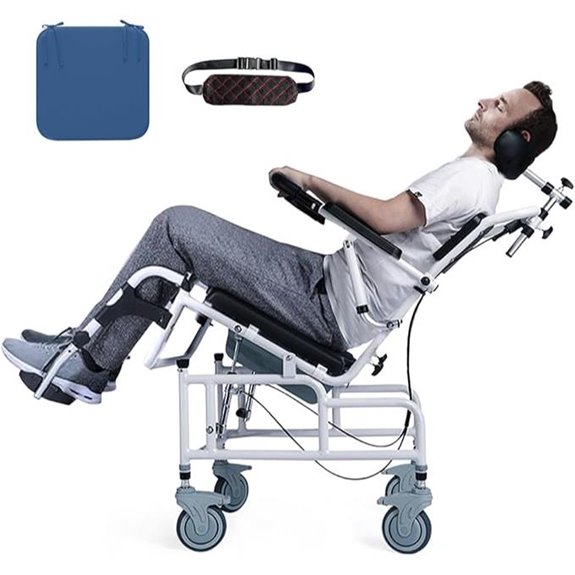 | Best Reclining Option | 4-in-1 Use: Shower chair, transfer chair, commode, transport wheelchair | Recline: 0°–45° recline | Wheels: 4 swivel casters | VIEW LATEST PRICE | Read Our Analysis |
| Reclining Shower Commode Chair with Wheels and Headrest |  | Best for Shampooing | 4-in-1 Use: Commode, shower chair, transport chair, shampoo chair | Recline: 90°–140° recline | Wheels: 4 braked wheels | VIEW LATEST PRICE | Read Our Analysis |
| 4 in 1 Rolling Shower Commode Chair | 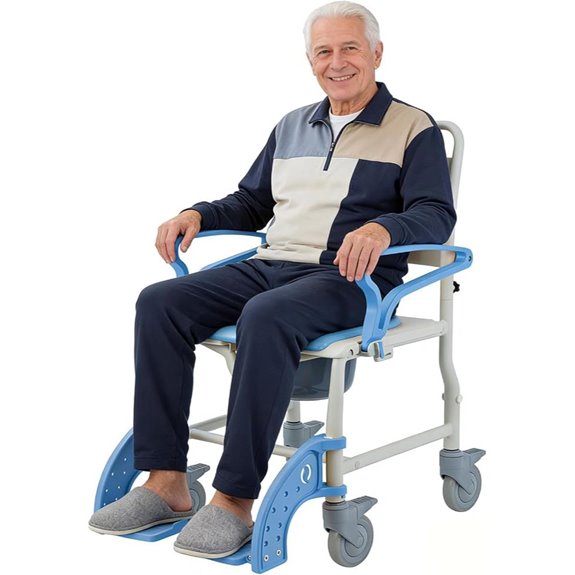 | Best Transfer Chair | 4-in-1 Use: Shower chair, bedside commode, toilet riser, transport chair | Recline: Not specified | Wheels: 360° lockable casters | VIEW LATEST PRICE | Read Our Analysis |
| Platinum Health Bariatric Shower/Commode/Transport Chair 600lb Capacity | 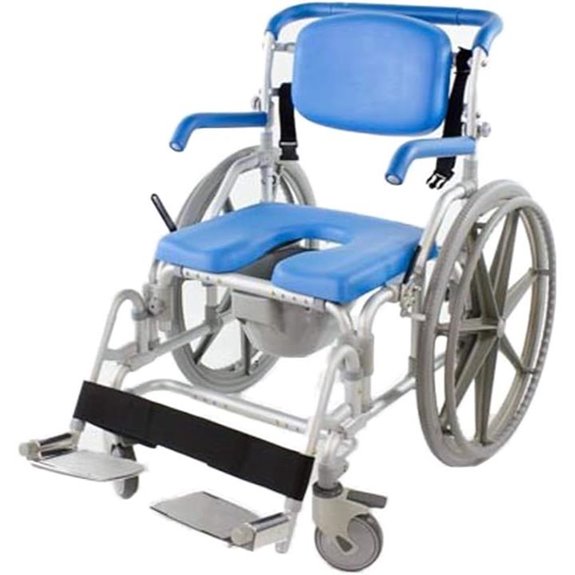 | Best Bariatric Pick | 4-in-1 Use: Shower chair, commode chair, transport chair, bariatric chair | Recline: Not specified | Wheels: Rear wheels and front casters | VIEW LATEST PRICE | Read Our Analysis |
More Details on Our Top Picks
Reclining Shower Chair with Wheels and Commode
Choose the reclining shower chair with wheels and commode when you need one device to handle bathing, transfers, toileting, and transport without swapping equipment. You get a lightweight, rust-resistant aluminum alloy frame rated to 300 pounds. Use the hydraulic lever to recline from 0° to 45°; set the headrest height and depth, and adjust seat height with 3-position leg extensions from 23 to 25 inches. Rely on the padded foam cushion, front-opening seat, and swingable footrests. Lock the four 360° casters. Do not ignore the 21-inch width.
- 4-in-1 Use:Shower chair, transfer chair, commode, transport wheelchair
- Recline:0°–45° recline
- Wheels:4 swivel casters
- Brakes:Wheel brakes
- Armrests:Not specified
- Footrests:Swingable, detachable footrests
- Additional Feature:Hydraulic reclining lever
- Additional Feature:Adjustable headrest
- Additional Feature:3-position leg extensions
Reclining Shower Commode Chair with Wheels and Headrest
The reclining shower commode chair with wheels and headrest is the right call when the user needs one frame to handle toileting, showering, transport, and shampooing without repeated transfers. Use the hydraulic lever to set the backrest and seat from 90° to 140°; that tilt supports shampooing and longer sitting. The aluminum alloy frame resists rust, meanwhile the water-resistant PU seat and high-density foam clean fast. Lock the four braked wheels. Keep the load under 330 lbs. Confirm doorway clearance above 22.4 inches. Flip up the armrests, transfer directly, and stop using flimsy substitutes.
- 4-in-1 Use:Commode, shower chair, transport chair, shampoo chair
- Recline:90°–140° recline
- Wheels:4 braked wheels
- Brakes:Wheel brakes
- Armrests:Flip-up armrests
- Footrests:Flip-up footrests
- Additional Feature:Waterproof PU upholstery
- Additional Feature:Recommended height 49–59 inches
- Additional Feature:Flip-up armrests
4 in 1 Rolling Shower Commode Chair
Use a 4-in-1 rolling shower commode chair when you need one platform to handle bathing, toileting, room-to-room transport, and toilet-riser duty without forcing repeated manual lifts. Choose the reinforced nylon frame; it carries 350 lbs and resists tip-over during transfers. Lock the 360° casters, engage the brake, then move over tile, hardwood, stone, or thresholds with controlled traction. Fit matters: the 23.35-inch width clears standard 23-inch doorways. Use the padded waterproof PU seat, swing-up armrests, and removable footrests for safer side transfers. Tool-free assembly takes 5–8 minutes. Clean fast.
- 4-in-1 Use:Shower chair, bedside commode, toilet riser, transport chair
- Recline:Not specified
- Wheels:360° lockable casters
- Brakes:Locking brake system
- Armrests:Swing-up locking armrests
- Footrests:Removable, height-adjustable footrests
- Additional Feature:Hidden detachable bucket
- Additional Feature:Tool-free assembly
- Additional Feature:90-day frame warranty
Platinum Health Bariatric Shower/Commode/Transport Chair 600lb Capacity
For bariatric amputee transfers where width, weight, and wet-surface stability all matter, the Platinum Health Bariatric Shower/Commode/Transport Chair is the hard-spec answer: it supports up to 600 lb, adjusts tool-free to fit through standard doorways, and gives you a single rig for showering, toileting, and transport. Use the padded seat, backrest, and armrests. Retractable arms and footrests simplify transfers. Large rear wheels let you self-propel; oversized front casters clear thresholds. Brake both ends. The commercial-grade foam won’t crack, bottom out, or absorb water, and it cleans fast. The removable commode pail turns it into a serious three-in-one workhorse.
- 4-in-1 Use:Shower chair, commode chair, transport chair, bariatric chair
- Recline:Not specified
- Wheels:Rear wheels and front casters
- Brakes:Brakes on wheels/casters
- Armrests:Retractable armrests
- Footrests:Retractable footrests
- Additional Feature:600 lb capacity
- Additional Feature:Width-adjustable frame
- Additional Feature:Self-propelling rear wheels
Factors to Consider When Choosing Shower Wheelchairs for Non-Ambulatory Amputees
You must match the chair to your body mass and transfer path first: verify weight capacity, seat width, and clear side or front entry so you can move without shearing the stump or overloading the frame. Check seat comfort and wheel braking next—use a contoured, non-slip seat with adequate drainage, and insist on locking casters that hold on wet tile, since a rolling chair in a shower is a failure condition, not a nuisance. Measure every doorway before you buy; if the wheelchair won’t clear the opening with margin, the rest of the spec sheet is irrelevant.
Weight Capacity
Weight capacity isn’t a margin you guess at; it’s a hard limit you calculate against. Add your body weight, any prosthesis, liners, wheel attachments, and expected caregiver-assisted load, then demand at least a 15–20% safety margin. Don’t buy a chair that merely matches your static weight; reclining, tilt, and movement create dynamic forces that spike above seated load. If you’re near 300–350 lb, move straight to bariatric-rated models—typically 400–600 lb capacity—without hesitation. Verify the frame, casters, joints, and recline hardware all share the same load rating; one weak component can fail under full-weight conditions. Ignore bargain chairs with vague specs. They’re engineered for shortcuts, not for you, and failure in wet environments is unforgivable.
Transfer Accessibility
Once the load limit is set, shift your attention to transfer geometry, since a shower wheelchair that can’t accept a clean lateral move is already a liability. Match seat width and chair width to your residual limb and socket clearance; compression causes skin shear and failed transfers. Specify swing-away or removable armrests, plus swing-detectable footrests, so slide-board or pivot entries stay unobstructed. Set seat height to the bed, toilet, or wheelchair within 1–2 inches; anything higher forces unnecessary lift and loss of control. Lock the casters. Test the brakes. If the frame creeps, reject it. Demand grab handles, transfer bars, or belt anchors, and verify Hoyer-lift compatibility when caregiver support is required. Unstable hardware isn’t acceptable.
Seat Comfort
Comfort starts with the seat, and if the surface bottoms out or pinches the residual limb, the chair fails the user before the first rinse. Choose high-density, water-resistant foam; anything softer compresses, shifts load, and drives pressure into the stump. Measure hip breadth and stump length, then match seat width and depth so your pelvis settles squarely without forcing the amputation side into rotation. Demand front-opening or cut-out geometry when hygiene access matters; it cuts shear on fragile skin. Verify height adjustability within 3–5 inches to align with transfer surfaces and reduce strain on the intact limb and caregiver. Use removable, antimicrobial, waterproof upholstery only. If it traps dampness or resists cleaning, expect skin breakdown, odor, and infection at the residual-limb site.
Wheel Braking
Brakes aren’t optional; they’re the only thing standing between a controlled transfer and a wet-floor collapse. You need rear or caster locks that halt rolling and stop 360° swivel during transfers, toileting, and repositioning. Choose lever or foot-activated mechanisms that you can reach from the seat and that caregivers can engage without strain. Demand low-force actuation; weak, sticky pedals fail when your hands can’t spare the grip. Specify stainless steel or sealed brake components, since corrosion in a shower kills holding power fast. Test the chair on tile, thresholds, and wet mats. If it creeps, skips, or lets the caster yaw laterally, reject it. Confirm the brake holds your full weight rating with no drift. Anything less is negligence in hardware.
Doorway Fit
With the brakes set, measure the chair against the route it has to clear, not the catalog photo. Check the outer width, then compare it to the narrowest doorway’s clear opening. Casters, armrests, and footrests can add real width, so include them. Demand 2–3 inches of clearance on each side; less invites scraping and jams. Don’t stop at static width. A tight bathroom punishes turning radius, especially during recline or transfer positions, when the footprint expands. Specify removable or flip-up armrests and swing-away footrests if you need to pass standard frames without overwidth failure. Finally, inspect thresholds and door swing. Raised sills and inward-opening doors can erase the margin you thought you had and trap the chair.
Frequently Asked Questions
How Do I Transfer Safely Into a Shower Wheelchair?
You transfer safely by locking the wheelchair, positioning it close, using a transfer belt or board, and keeping your weight centered. Ask for help if needed, and move slowly to avoid slipping or injury.
Can Shower Wheelchairs Fit Standard Bathroom Doorways?
Yes, some shower wheelchairs fit standard bathroom doorways, but you’ll need to check widths first. You should measure your doorway, then compare it with the chair’s overall width, especially armrests and footrests.
How Often Should Shower Wheelchair Brakes Be Checked?
You should check shower wheelchair brakes before every use, and you should inspect them weekly for wear, loosening, or damage. If they feel sticky or weak, you’ll want to fix them right away.
Are Shower Wheelchairs Covered by Insurance or Medicare?
Yes, you may get coverage, but that hinges on your plan and medical necessity. You’ll need a prescription, documentation, and sometimes prior authorization. Medicare often covers durable medical equipment, though shower chairs aren’t always included.
What Maintenance Prevents Rust on Shower Wheelchair Parts?
You can prevent rust by rinsing off soap, drying all parts after each use, wiping joints, and checking chips in coatings. You’ll additionally want to lubricate moving parts and store it in a dry, ventilated area.


