Hi, I am Aria, welcome to my life!

How to Walk on Sand With a Prosthetic Leg
Walking on Sand With a Prosthetic Leg? These Tips Will Surprise You


Learning how to walk on sand with a prosthetic leg is easier than most people expect once you know what to adjust. Loose, shifting ground can throw off your balance and leave your residual limb sore if you head out without a plan.
A few simple habits, like starting on firm, damp sand and taking shorter steps, can make a big difference. This guide covers the essentials: choosing the right beach spots, pacing yourself, protecting your prosthesis from salt and grit, and checking your socket for rubbing.
You’ll also find tips for planning ahead so every beach trip feels safer and more comfortable. Keep reading for the step-by-step approach that helps you walk with confidence across the sand.
Quick Answer
- Walk on cool, damp, compact sand near the water, away from waves, slopes, shells, and deep footprints.
- Test the sand by pressing your heel into it; shallow prints suggest firmer footing.
- Take short, slow steps, start with a brief walk, and turn back before fatigue affects your balance.
- Check your socket fit and skin at breaks; remove the prosthesis to dry your limb and liner if they become damp.
- Clean sand from your prosthesis after walking, then rinse gently with fresh water and dry it completely.
Choose and Protect a Beach-Ready Prosthesis
For regular beach trips, I use a dedicated beach prosthesis and keep my daily prosthesis away from sand and salt.
A separate setup costs more at first, but it protects my daily limb from grit and corrosion.
When I compare beach devices, I look for sealed joints, waterproof materials, and a simple foot that handles swimming and walks along the shore.
I ask my prosthetist whether the model tolerates full submersion, and I check its weight and how it fits with my regular liner and socket.
Prices vary a lot, so I request a written quote that covers fitting, adjustments, and replacement parts. After each trip, I rinse the metal parts with fresh water to prevent corrosion.
Then I dry every part fully before storage. I never put a damp device in its bag.
Protective covers and barriers help too. I add them where my prosthetist recommends, since sand can grind into the joints and wear them down.
For extra protection against wet sand, I look for watertight seals that maintain continuous skin contact and withstand repeated use.
I always choose a dedicated beach prosthesis with replaceable parts.
Choose Firm Sand and Cooler Beach Hours
As an amputee, I plan my beach walks for early morning. The sand is cooler then, and the damp shoreline is usually firmer under my prosthetic foot.
I choose this time because solid footing matters more to me than a sunrise outing. Soft sand makes my gait uneven and tires my residual limb quickly, so I want a steady surface from the start.
Dark sand and sunlit surfaces heat up fast. Cooler air keeps my residual limb comfortable and helps me avoid sweat and heat buildup inside my socket and liner.
Look for damp, packed sand near the water. Packed sand holds its shape under weight, while dry, loose sand shifts and sinks.
Wet sand isn’t guaranteed to stay firm, so I check the surface before I step onto it. A silicone suspension sleeve can help keep your socket anchored on uneven terrain.
Before I go, I check the tide and local access rules. A narrow strip of beach can disappear at high tide, and that leaves me stuck on soft dunes or rough rocks.
I look for a shaded, cooler window and a shoreline with a wide firm band. I avoid soft dunes altogether.
If the sand gets hot by midmorning, I change my plans. A boardwalk stroll is a good backup because its hard, flat surface protects my liner and my skin.
Walk on Sand With a Prosthetic Leg

As an amputee, I stick to firmer, damp sand and slow my pace.
Soft sand can turn a short stroll into a workout for my residual limb and prosthetic leg.
I take shorter steps and give myself time to adjust my balance.
Rushing won’t make the beach any flatter.
Start with a brief walk, then rest before you tire.
Fatigue makes it harder to keep your balance and control your prosthetic knee.
After the walk, I rinse the sand off my liner and socket.
Sand trapped against my skin can cause rubbing and sores, so I dry everything fully before I put my leg back on.
For pool therapy or beach walking, some amputees find that specialized gear with silicone gel panels helps provide gentle buoyancy and a steady compression of 15 – 20 mm Hg to support the residual limb.
Choose Firmer Sand
As an amputee, I always choose the firmest and most even sand I can find. I aim for the cool morning hours, because sand is often firmer before the sun heats it up.
I look for packed sand near the shoreline rather than loose dunes. Soft sand can swallow my prosthetic foot, throw off my balance, and twist my ankle joint.
Sand’s geological makeup affects how well it holds my weight. Midday heat matters too, since hot sand can warm the dark parts of my prosthetic and irritate my skin.
Before I step onto a patch, I press my heel into it. Shallow prints tell me the ground is firm enough to hold me.
I pick damp, compact sand close to the water, but I stay well back from the waves. Wet sand packs tightly, and a strong wave can knock me off balance.
I avoid slopes, shells, and footprints because they make my footing uneven. Each of these can shift my weight onto one side of my socket.
Before I move onto softer areas, I check that my socket feels secure. A loose fit can let my residual limb slip inside the socket and cause a fall.
If I’m unsure about the sand, I take the boardwalk. Falling into soft sand isn’t worth the risk to my limb or my prosthetic.
I also apply this same principle to indoor surfaces, where a non-slip surface like those on commercial-grade mats helps stabilize my footing during long standing tasks.
Adjust Your Walking Pace
As an amputee who walks on a prosthetic leg, I slow down on sand and take shorter, steadier steps.
Trying to keep my usual pace is a fast way to wear myself out.
Each step asks my socket, my residual limb, and my prosthetic foot to work harder as they sink into the sand.
I aim for a pace that lets me talk comfortably.
When I start to lose my balance or feel my energy fading, I pause and rest.
Sand can take about 2.7 times more energy than firm ground, so there’s no medal for rushing.
This extra strain on my muscles makes me appreciate tools that support daily comfort, like TENS and EMS devices that ease nerve-related discomfort after long walks.
Protect Your Skin While Wearing a Prosthetic Leg
I protect my skin first, because a damp, sandy socket can start to itch within minutes on a beach walk. Before I put on my prosthesis, I apply a skin safe protectant to my residual limb and check that my liner fits well enough to prevent rubbing. I also use a medical-grade silicone patch over any bony prominences to help reduce shear and cushion pressure points during the walk.
During breaks, I take off my prosthesis, clean and dry my residual limb, and let my skin breathe. Sand and sweat cause problems quickly, so I never leave them sitting on my skin.
After a long day, I check my residual limb for redness or small sores before I put my socket back on. Catching a problem early keeps me out of bed and back on the sand.
Prevent Socket Irritation
Keeping my socket clean and dry is the first step I take to prevent irritation. My residual limb sits inside the socket all day, and trapped moisture can feed bacteria and cause rubbing.
Before every walk, I check how my socket fits. Sand and heat can shift my residual limb, so a fit that worked at home may feel different outside.
I apply a skin protectant before I don my prosthetic, but only after my prosthetist confirms it’s safe for my skin. I use a thin layer so the product doesn’t build up under my liner. If I notice any early skin breakdown, I might use a product like LMNOOP Wound Care Cream to support healing.
I always carry a spare liner or sock. When one gets wet, I swap it out so the damp fabric doesn’t keep rubbing the same spot.
After I walk for a few minutes, I remove my prosthesis and look at my residual limb. I check for redness, heat, or a new sore, and I note exactly where it appears.
If irritation keeps coming back, I call my prosthetist to adjust the socket. I never tough it out, because a small sore can grow into a wound that keeps me off my prosthesis for weeks.
Daily hygiene is part of my routine. I wash my residual limb with mild soap and water, dry it fully, and let my skin rest before I put on a fresh liner.
I also tell my prosthetist about any irritation I notice, even when it seems minor. Early questions often save a lot of pain and downtime.
Keep Skin Clean and Dry
For beach walks, I keep my residual limb clean and fully dry before I put on my prosthesis. This is my first line of defense against moisture, because wet skin invites bacteria and friction. Fragrance-free, dye-free formulas are a better baseline for reactive skin if you need a moisturizer before donning your liner.
Salt water and sand can irritate the skin on my residual limb. After every swim, I rinse the limb with fresh water, then I pat the skin and my liner dry.
Sweat builds up fast in hot sun, even during short breaks. At each break, I take off my liner, let the limb air out, and dry the liner before I put it back on.
Before I head out, I check my skin for redness or heat. Early warning signs are much easier to manage than a full sore.
I always carry a spare liner, clean dry socks, and antibacterial wipes in a sealed bag. The sealed bag keeps sand away from my supplies, and the wipes handle quick cleanup on the beach.
If my skin stays sore, cracked, or hot, I stop walking. I let the limb dry completely, then I contact my prosthetist right away.
I don’t push through pain on a beach day. Sand already causes enough trouble without adding a skin problem.
Clean Your Prosthetic Leg After Sand and Saltwater
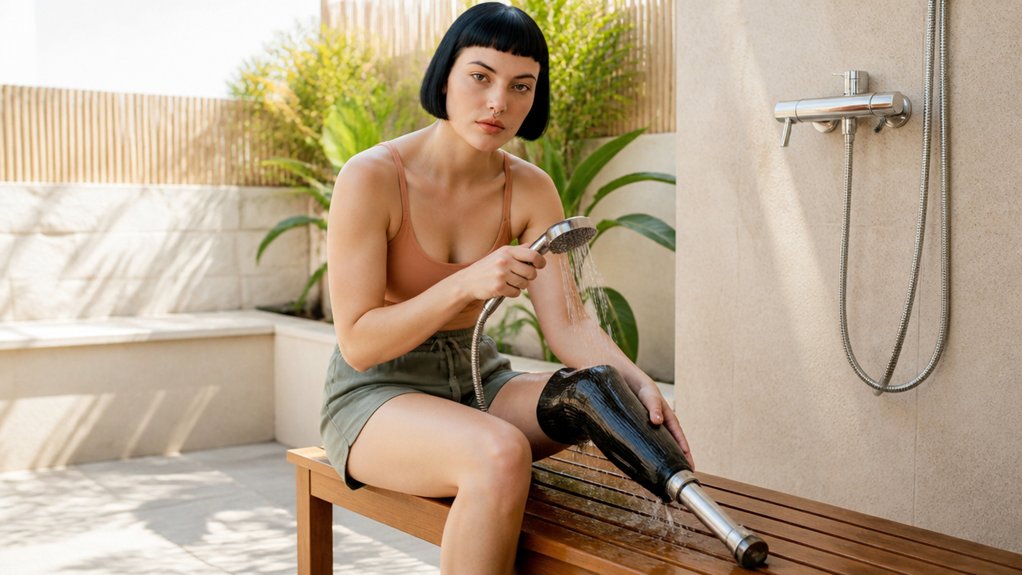
After every outing on sand or in saltwater, I clean my prosthetic leg right away. Sand grinds into the knee joint and ankle hinge, and it wears them down faster than normal use would.
Salt left on metal parts can start corrosion, so I never wait until the next day. First, I brush off dry sand with a soft cloth, paying close attention to the knee hinge, the pylon, and the foot.
Brushing first keeps grit from getting pushed deeper into the moving parts once water hits them. Next, I rinse the exposed parts with fresh water and a gentle stream.
I never point a hard hose straight into a joint, because pressure can force water and grit past the seals. If a little salt or grime stays on the surface, I wipe that area with mild soap on a damp cloth.
Then I rinse off all the soap, since leftover soap can attract dirt and dry out the liner. Next, I dry every part with a lint free towel.
After that, I let the leg air dry fully before I put on the liner or store it. Trapped moisture can lead to rust in the metal parts and skin problems inside the socket.
I also inspect the leg each time. I check the screws, the liner, and all moving parts for looseness or grit.
If anything feels loose, gritty, or stiff, I stop using the leg and call my prosthetist. I follow my prosthetist’s direction for any oiling or taking apart of components.
I store the leg in a clean, dry place away from sand and salt. Keeping the leg dry between outings helps the metal parts last longer.
Manage Fatigue While Walking With a Prosthetic Leg
Once my prosthetic leg is clean and dry, I plan sand walks as short outings. Walking on sand asks much more of my body than walking on firm ground.
My pace slows, and my energy use can climb fast. So I pick a small goal, such as five minutes of walking, and I turn back before my gait starts to fall apart.
I also rest on a stable seat before I get worn out. Waiting until I feel completely drained makes recovery take much longer.
Each pause gives me a chance to check how my socket fits on my residual limb, since heat and sweat can change how it feels. I also watch my steps closely, because tiredness can make my balance less reliable.
When I feel tired, I stop instead of telling myself to walk one more minute. That kind of bargain rarely works out in my favor.
I build my stamina slowly over time. If tiredness keeps cutting my walks short, I call my prosthetist to talk about adjustments.
I keep my walks brief, pause early, and stop while I still feel steady on my prosthetic leg.
Find Accessible Beach Routes and Boardwalks
As an amputee who loves the beach, I choose a paved boardwalk or a firm shoreline path before I try deep, soft sand. Firm surfaces are easier on my prosthetic leg and save my energy for enjoying the water.
Before I leave home, I check the beach map and call the access office. Posted details are more reliable than a photo that looks inviting.
When I review a beach, I look for shoreline pathways, ramps, and smooth surfaces. A parking spot with an accessible sign only gets me to the starting line.
Then I ask the access office whether the route reaches the water and how far the firm path runs. A path that ends at the dunes leaves me stuck in sand.
I also check for railings, benches, shade, restrooms, and steep slopes. Steep grades strain my residual limb and my socket, so a gentle ramp matters more than a short distance.
If sand blocks my route, I ask whether the beach offers a beach wheelchair. Many beaches lend them for free or for a small fee, so I reserve one ahead of time.
Finally, I save the route, note the surface type, and plan a shaded spot to rest. That preparation prevents surprise detours, which are much less enjoyable on a prosthesis, so I plan my access before I plan my swim.
Frequently Asked Questions
Does Health Insurance Cover a Dedicated Beach Prosthesis?
Health insurance may cover a dedicated beach prosthesis when your plan and prosthetist can show it is medically necessary. Approval rarely depends on the device name alone.
Ask your prosthetist for a letter explaining how a waterproof leg supports your daily function or hygiene needs. Submit it with your prescription and request a written coverage decision before you buy.
Check the annual coverage cap, whether waterproof add-ons are billed separately, and any exclusions for recreational items. Many plans label a swim leg as recreational, so read that wording closely.
Should I Schedule a Prosthetist Check Before My First Beach Trip?
Yes, I would schedule a prosthetist check before your first beach trip, since sand, salt, and heat can change how your prosthesis feels. Ask them to assess your socket fit, review your balance training, and recommend protection and adjustments for changing limb volume.
Heat and residual limb swelling often shift by midday, so a socket that feels snug in the morning may rub by afternoon. Before the visit, wear your liner and socket for a full day at home and note any pressure spots.
Bring that log so your prosthetist can address problems before sand gets involved. Rinse your components with fresh water after every swim.
What Signs Mean Skin Irritation Needs Medical Attention?
Skin irritation needs medical attention when redness persists, pain worsens, open sores appear, warmth spreads, unusual discharge develops, or fever begins. As an amputee who wears a prosthesis every day, I treat these as warning lights and urge you to contact a clinician without delay if symptoms worsen or you feel unwell.
Residual limb skin breaks down quickly under a liner and socket, so a spot that looks minor can turn into an infection within a day. Today, trace the edge of any redness with a skin marker, take a photo, and recheck it in four hours.
Watching whether that border moves helps you explain any changes clearly to your provider. Keep a fever log too, noting the time and temperature.
Can I Try Adaptive Beach Sports Without Walking on Sand?
Yes, you can try adaptive beach sports without walking on sand, and many shorelines now make it easy. Adaptive kayaking and a beach wheelchair are two of the most popular options for enjoying the water’s edge.
Before you go, talk with your prosthetist about access, equipment fit, and skin comfort. Ask whether your socket or liner will hold up to saltwater, and whether you should bring a spare liner.
Today, call the beach or your local adaptive sports program and ask whether they offer beach wheelchairs with balloon tires or kayaks with seat supports. Many parks also post accessible mat routes, so check those before you arrive.
What Details Should I Record to Help My Prosthetist Improve Future Adjustments?
Record sand depth, step asymmetry, socket fit, fatigue timing, discomfort, distance, weather, and rest breaks so your prosthetist can improve future adjustments. These details reveal patterns that a single appointment never shows.
Note your socket fit on a scale from 1 to 10 each evening, and mark any red spots that linger longer than 30 minutes after you remove the prosthesis. For example, if your step asymmetry worsens after two hours on sand, your prosthetist can adjust alignment or foot stiffness before a sore develops.
Bring this prosthetic fitting log to each visit and compare notes together, so adjustments rely on real-world use rather than memory.
Rounding Up
My verdict: start on firm, damp sand, keep your outing short, and let comfort – not stubbornness – set the pace. Walking on sand can use about 1.6 times the energy of walking on firm ground, so fatigue is a safety issue, not a character test. I’d check your skin afterward, rinse and dry the prosthesis as its maker directs, and use a boardwalk when the beach gets rough. Your beach day is one you can repeat.